

Unlocking the Mysteries of Copyright in Surface Design with Sharon Givoni
Delving into the realm of surface design, it’s easy to find oneself mesmerised by an illustration that seems to ignite a spark of inspiration for your next project. The excitement builds as you consider transforming this spark into a unique fabric pattern. Yet, a pivotal question casts a shadow over your enthusiasm: How can you ensure your design respects copyright law without infringing on the original work? Will you breach copyright, or what if someone copies you and how can you protect against this?
The path through copyright law is intricate, and navigating it requires more than a cursory understanding of rules. It demands a deep dive into the legalities that govern artistic expressions. This article, while by no means comprehensive, aims to shed light on some of these complexities, guided by the expertise of Sharon Givoni, a renowned lawyer with a rich background in copyright law and surface design.
Understanding Copyright Infringement
In Australia, the Copyright Act (Cth) 1968 sets the stage for what constitutes copyright infringement. Simply put, infringement occurs when there’s a “substantial reproduction” of another’s work, be it a pattern, drawing, or any artistic piece. Artistic works, regardless of their merit, are protected by copyright law in Australia but they need to be in material form (they can’t just be a concept or an idea floating in mid-air) and they need to be original in the sense of being independently created. Making unauthorised reproduction of someone else’s pattern can be a costly legal misstep and under the copyright rules, even if you did it without meaning to, this won’t be a defence.
Dispelling the Myth of the 10% Rule
Before going any further, I like to dispel a very common misconception in creative circles. It is referred to as the “10% rule,” a mythical safety net that some believe allows for minor alterations to bypass copyright infringement.
Under the law however, no such rule exists. Instead, the focus is on “substantial reproduction” and the copying of the work’s core expression, not arbitrary percentages. There are all sorts of interpretations of what this phrase actually means that the cases have applied over years but I wont go into them here.
Contractor Collaborations and Copyright
Many designers employ contractors, under the assumption that payment equates to a transfer of copyright ownership.
However, I always like to stress that a formal, written copyright assignment is generally necessary to secure the transfer of copyright. Remember to that if you assign the copyright in your own surface design, technically you will no longer be able to use it or reproduce it yourself so be careful.
Inspiration vs. Infringement: Navigating the Fine Line
How can surface designers draw inspiration without crossing into infringement? There is no black and white answer and each case depends on the image in question and how it was created. Try and keep records of how you came up with a design and even the sources you used for inspiration.
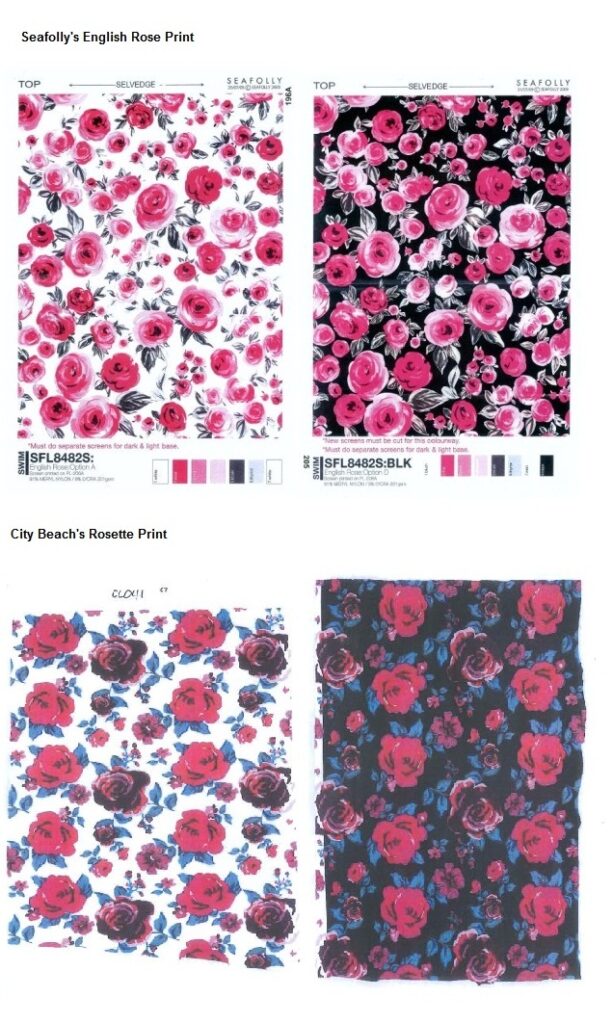
The case of Seafolly Pty Ltd v Fewstone Pty Ltd [2014] FCA 321 involved the patterns above, the top ones being the Seafolly and bottom, City Beach, the alleged copyright infringer. The court found that City Beach infringed Seafolly’s copyrights in the English Rose noting objective similarities and substantial reproduction of these designs in City Beach’s garments and said that copyright infringement does not require exact replication but rather the substantial copying of copyrighted elements. This decision emphasised the importance of originality and the legal implications of drawing too closely from existing designs.

About the author Sharon Givoni
Sharon Givoni, with her extensive experience and passion for the creative industry, has become a beacon for designers seeking to navigate copyright laws. Her book, “Owning It: A Creative’s Guide to Copyright, Contracts, and the Law,” along with her numerous speaking engagements, show her commitment to empowering creatives with the knowledge to protect their work.
This article does not substitute for legal advice. For specific legal concerns, engaging with a seasoned lawyer like Sharon Givoni can provide the tailored guidance needed to navigate the complexities of copyright law confidently.
Join Sharon Givoni and Rachael King for an upcoming series of enlightening Zoom discussions on copyright law, contracts, and the impact of AI on surface design. These sessions are designed to equip Australian Surface Designers with the legal insights necessary for their creative journey.
Please note these are LIVE sessions only. They will not be recorded for future viewing:
1. Topic: Australian Copyright law and you with Sharon Givoni & Rachael King
Time: Mar 13, 2024 04:30 PM Canberra, Melbourne, Sydney / 03:30 PM Brisbane
https://us04web.zoom.us/j/71029351284?pwd=zfkueUzZjjpFagsnkha4c3oWkR8UfB.1
Meeting ID: 710 2935 1284
Passcode: 0rqnWm
2. Topic: Contracts for Surface Designers with Sharon Givoni and Rachael King
Time: Mar 20, 2024 04:30 PM Canberra, Melbourne, Sydney / 03:30 PM Brisbane
Join Zoom Meeting
https://us04web.zoom.us/j/71468577350?pwd=7aTPLMaADmPbdZLAK1ht2P7s5Vl2lW.1
Meeting ID: 714 6857 7350
Passcode: 2fp6TF
3. Topic: What AI means to the Surface Designer with Sharon Givoni and Rachael King
Time: Mar 27, 2024 04:30 PM Canberra, Melbourne, Sydney / 03:30 PM Brisbane
Join Zoom Meeting
https://us04web.zoom.us/j/73386151717?pwd=E9C5q0MLbFHe9ZEkAJVDoOM4fBoAAG.1
Meeting ID: 733 8615 1717
Passcode: 8HGzQp